What Schools Cannot Do
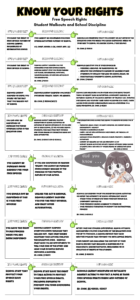
- Punish you for off-campus speech.
- Suspend you for exercising free speech at school or for distributing flyers, petitions, wearing badges, or student press articles.
- Punish you more harshly because of your viewpoint or the political nature of your action.
- Suspend or expel you solely for walking out, or solely for truancy/tardiness/absence.
- Suspend for “disruption/defiance” if you’re not in high school, or if it’s a first high-school offense and other corrections weren’t tried.
- Suspend everyone just for walking out without individualized review and a chance to tell your side.
What Schools Can Do
- Discipline you for offenses under the Education Code that occurred on the way to, during, or leaving school.
- Limit school speech that is obscene, libelous/slanderous, incites law/rule violations, or substantially disrupts school.
- Use non-suspension responses for truancy/tardiness/absence (e.g., detention, community service, Saturday school) and refer chronic truancy to SARB/probation (only for more than 3 turancies).
- Suspend/expel only for listed offenses (e.g., threats/violence/harassment; weapons; drugs/tobacco; theft/vandalism/robbery; obscene acts; disruption/defiance with limits).
- For disruption/defiance suspensions: only applied to high school students and only after other corrections failed.
- Suspend only after a due process conference, up to five days.
Due Process Rights
- You must get notice and a chance to present your side before suspension; decisions must be based on specific Education Code violations.
- You can challenge an educational record that is inaccurate or in violation of your rights.
Staff Protections
- Staff may act to protect student speech and cannot be disciplined or retaliated against for doing so.